ENCOUNTERS by George Sturm
John Mazzola
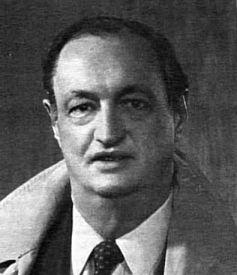
Music. Law. The alcohol propensities of audiences. Security
guards. The steam capacity of boilers. Pesto and marinated carrots. Union
negotiations. Fund raising. Television. Architects and artisans and every
conceivable genre of artist. And family, a ritornello constantly appearing
between the seemingly unrelated and sometimes surrealistic dots which make
up the canvas of John Mazzola's life. His family, and his Rhode Island garden
where he grows many of the ingredients he uses in preparing the gourmet dishes
for which he has an impressive reputation. It is as if the communion with
wife Sylvia and daughters Alison and Amy — and with the regenerating soil — were constantly recharging his battery, making it possible for him to make
vital, productive and imaginative connections among the countless details
of his daily labors. John Mazzola is President and Chief Executive Officer
of Lincoln Center for the Performing Arts.
At the age of 53, Mazzola's schedule and commitments often
keep him engaged 16 or more hours a day. Perhaps it is the very variety of
his tasks which makes him handle his job with an ease, grace and low-keyed
wit that must be observed to be understood. Sit in his office any random
half hour and you will discover why he is so effective: he's having one helluva
good time.
He comes from a family he describes as "active."
His father was a lawyer who played violin and who encouraged his children,
John and his sister and brother, to be participants in many aspects of their
community, Bayonne, New Jersey. Young John was a superior athlete and a voracious
reader. While he was fond of the theatre, he was wary of music as bordering
on the sissyish. As if to declare his independence from the musical values
of his father, he took up the drums in high school. "My main ambition
in life was to move to New York City." He did, by way of Tufts University
in Massachusetts, from which he received his B.A., leading to Fordham Law
School. On graduating with his Juris Doctor in 1952 he became associated
with the firm of Milbank, Tweed, Hadley & McCloy, where he met many of
those people, including members of the Rockefeller family, who were to lead
him to Lincoln Center a decade later. The Center, in fact, was one of his
personal clients before it had any buildings. Thus, Mazzola literally grew
with the job. He became involved with the opening of what was then Philharmonic
Hall (now Avery Fisher Hall): legal problems and licenses, union negotiations,
restaurant planning, liaison with the various arms of city government, network
and press coverage, an endless stream of logistics. How did he know what
had to be done? "I discovered early on that if you hadn't done something,
somebody would eventually remind you. And if nobody reminded you, it didn't
have to be done."
"In 1962, no one knew what Lincoln Center would turn out
to be. "Twenty-five years ago, if you said `performing arts center,'
nobody would know what you were talking about. Today, there are about 20
of them meeting our definition: centers with more than one theatre, more
than 3,000 seats, and more than two constituent companies. But Lincoln Center
is quite different from all the other performing arts centers in the United
States. It's not a group of buildings. It's the ten companies which are
Lincoln Center: the Center itself and the activities it undertakes independently,
the Metropolitan Opera, the New York City Opera, the New York Philharmonic,
the New York City Ballet, the New York Public Library and Museum (Performing
Arts Division), the Film Society of Lincoln Center, the Chamber Music Society
of Lincoln Center, the Theater Company of Lincoln Center, and the Juilliard
School."
Lincoln Center for the Performing Arts owns and operates
the halls, grounds, and garages making up the 14 acre complex on Manhattan's
west side. This is a west side story born of urban squallor and culminating
in the most daring and ambitious cultural adventure since ancient Athens.
It includes a magnificent plaza, Damrosch Park with its band shell, the Metropolitan
Opera House, the New York State Theater, Avery Fisher Hall, the Vivian Beaumont
Theater, the Library and Museum, Alice Tully Hall, and the auditoriums in
The Juilliard School. The resident companies are its principal tenants, each
sharing in the cost of lighting, heating, air conditioning, and securing
the grounds. (Approximately $650,000 is spent annually for safeguarding the
grounds outside the buildings, and another half million inside.) The halls
are available to others when not in use by a resident company. Except when
a house is forced to be closed, owing to remodeling or the preparation of
new productions, most of the buildings are in operation all year round.
In addition to providing services, Lincoln Center contributes
significantly as its own entrepreneur, producing such highly successful series
as the Mostly Mozart Festival (originally called Mid-Summer Serenades and
renamed in 1970), the Great Performers Series, the New and Newer Music Series,
and the Lincoln Center Organ Series. In charge of this divergent programming
activity is William W. Lockwood. Mazzola: "Bill is an absolute wiz who
does everything but write the music. He thinks up the series, designs the
T-shirts, chooses the artists and the programs, and he does it all with a
huge staff: himself and one assistant!"
Lincoln Center also produces the free Lincoln Center Out
of Doors Festival each summer. The Out of Doors Festival utilizes the plaza
and park areas as a stage for national and international dance companies,
symphonic and chamber music groups, and theatre companies presenting three
weeks of continuous entertainment.
Along with these programs, Lincoln Center also has an educational
branch, the Lincoln Center Institute, "The Institute coordinates the
student programs of the constituents. In about 1970, Mark Schubart, head
of the Lincoln Center Institute, came to the conclusion that — rather than
simply exposing kids to a performance — something more should be left behind
in their heads. He developed a formalized way of working with teachers who
come in the summertime and participate in a tightly controlled and prepared
curriculum which shows them how to peel the onion: seeing the ballet, for
instance, and then working with the choreographer who explains what he was
trying to convey and how, and with the dancers themselves. We send out young
performing artists to work with the teachers who will, in turn, work with
students. The curriculum which is being developed here can be exported to
any area where there is a center of performing artists. The idea is basic
esthetic education, how to look at what you are seeing and hear what you
are listening to."
Perhaps the most widely enjoyed dimension of Lincoln Center's
own production work is television's "Live from Lincoln Center,"
which has enabled a national and international audience to share the wonders
of the Center's artistic achievement, with the help of a handful of enlightened
corporate sponsors, the National Endowment for the Arts, the Corporation
for Public Broadcasting, and, of course, the tremendous technological advances
which have made it possible both to present and to preserve the best of the
performing arts for unimaginable numbers of spectators and listeners. Broadcasting
activities are the domain of John Goberman, Director of Media Development.
Under his guidance, Lincoln Center has become one of the largest producers
of cultural programming in America. Having been the first to develop the
concept, the Center's staffers are frequently asked to assist other cities
and institutions in setting up broadcast production units of their own.
What did John Mazzola think were the chief functions of the
President of Lincoln Center? "To be responsible for everything that
goes wrong," he shot back. "If anything goes right, I can tell
you exactly who it was who did it." The roughly 65 people working for
Lincoln Center itself (as separate from its resident companies) cover a broad
gamut of assignments: educational, personnel, union negotiation, programming,
public information, community programs (a generous assortment of free performances
are given each year), media development, financial development, and a large
accounting department which services the Center and its ancillary components.
Listening to Mazzola describe his work it is suddenly clear that he is equally
comfortable with the most minute details (of which there is a profusion without
end) and with the loftiest principles upon which so complex a structure must
be based. His dispassionate awareness of economic fundamentals is a great
asset. "A man with a multi-million dollar organizational budget once
told me, `Do you realize that I raise half my money from four people? Isn't
that great?' And I said that I'd never heard anything so horrible in my life.
One accident in the parking lot between the two of them, and you're out of
business. .. .
If an institution has high quality, it must be saved before
anything else. If times are tough and cut-backs are unavoidable, you cut
out whatever is necessary, but you save the institution. One thing to do
is to build an endowment which will give you some strength to lean on when
things are tough."
We asked about his reaction to the charge that arts organizations
are "elitist" and used only by a tiny segment of our national population.
"There are all kinds of catch words used to inflame people. We have
audiences of five million people at Lincoln Center. That's a helluva lot
more than go to Yankee Stadium each year. But you wouldn't hear anyone call
Yankee Stadium `elitist,' even though you see Cadillacs and Mercedes driving
up around there. If, for example, we get money cut off for our `Live from
Lincoln Center' project, we'll still have that concert here in New York,
but the people in Duluth and Elk City are going to miss it." One is
constantly hearing about the cost of the arts, but not enough attention is
paid to the positive economic implications of the successful arts center.
"Our studies indicate the $345 million a year is generated into the
economy of the City of New York, plus the fact that our existence has stimulated
$700 million to a billion dollars in new construction, producing another
$50 million in real estate taxes. But you can't get a nickel out of the City
because the City is bankrupt."
John Mazzola believes that everyone in the arts plays an
important role in the community at large and is an integral part of that
community. It is important that the community always be identified. In the
case of Lincoln Center, is it the west side? Manhattan? the five boroughs?
the Metropolitan area? the United States? The answer may be different for
each event, and so will be the language selected to bring about the most
effective dialogue between artists and those who use their art. "Whenever
we do something on the Plaza, my theory is that what we're doing is generating
a bigger flow of people. There's no ticket take out there. I've been asked
why we do things where we'll only have to clean up the mess. It's simple:
if we didn't have the mess, we wouldn't have had the people. But I think
that, on every level with people, you are a part of your community, and the
more you succeed in attracting many different kinds of people to use your
many different kinds of energy, the more you will have succeeded."
|